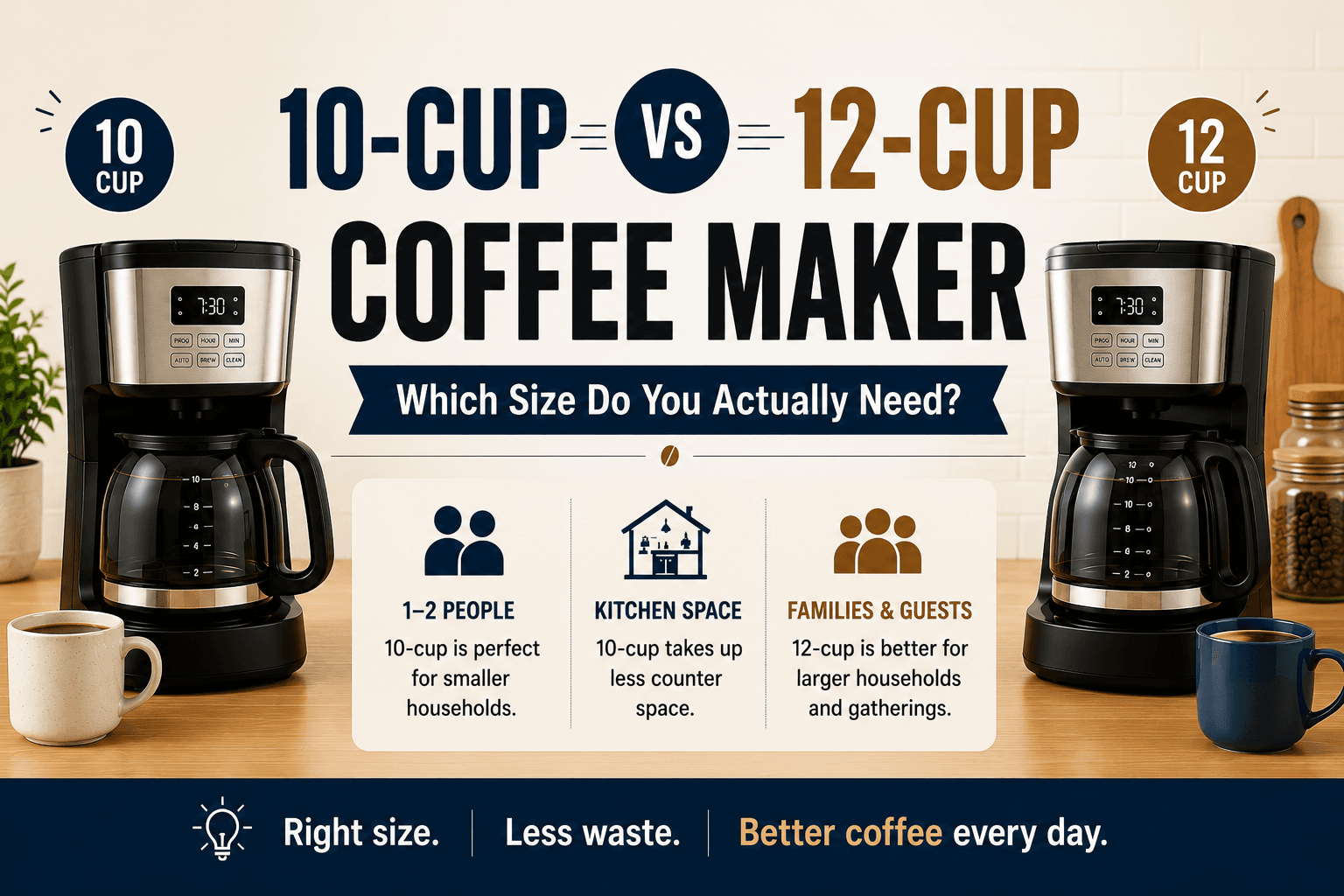
A 10-cup and a 12-cup coffee maker can look almost identical on the counter. But when you're brewing every single morning, those two extra "cups" start to matter — just not always in the way you'd expect.
For a lot of households, a 10-cup machine is already more than enough. A 12-cup model makes more sense for families, frequent guests, or anyone who regularly empties the carafe before the morning is over. And there's a catch worth knowing up front: a coffee maker "cup" usually isn't the same size as the mug you drink from.
So before you reach for the bigger number just because 12 sounds better than 10, here's what those capacities actually mean.
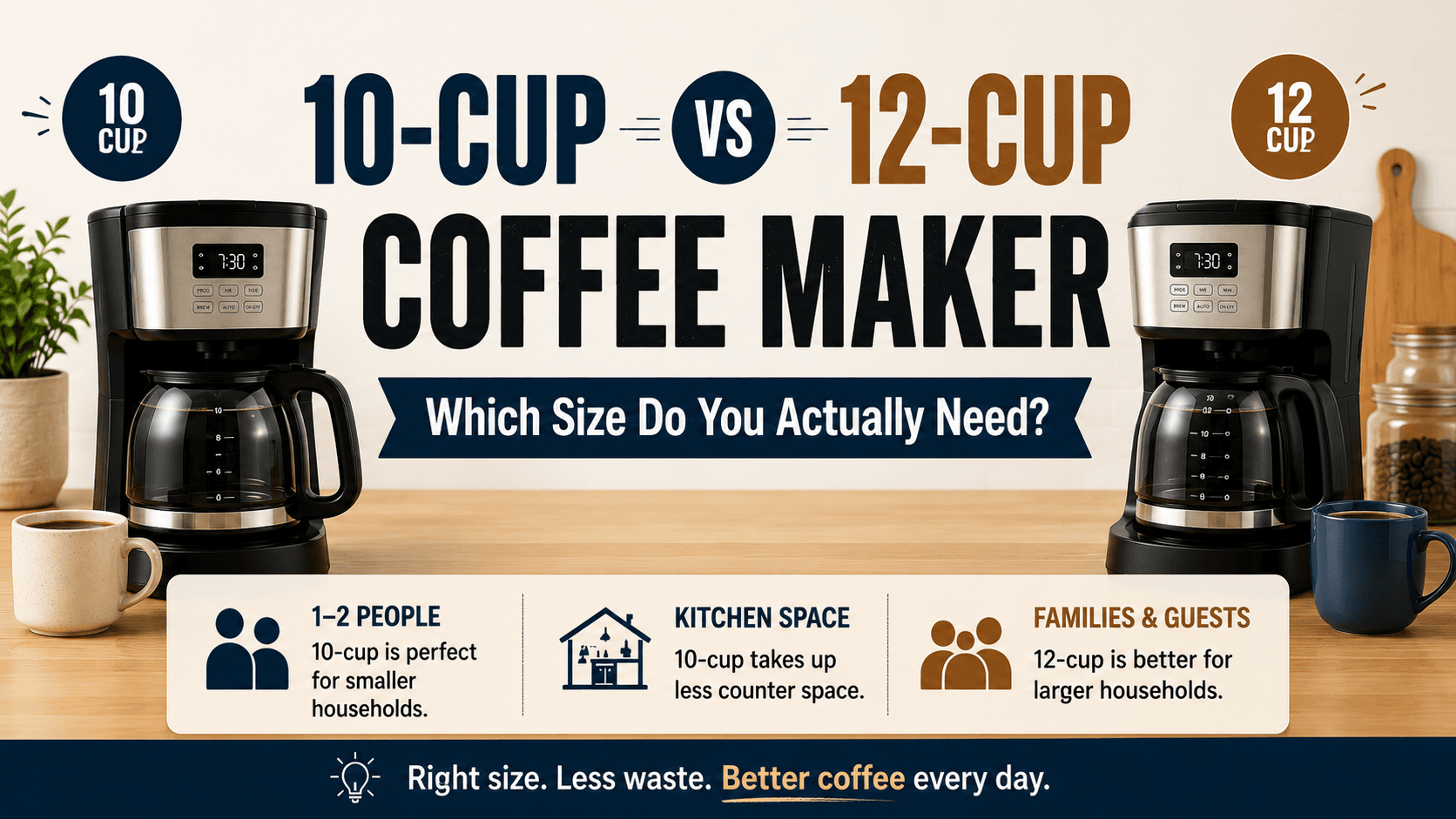
Quick Answer: 10-Cup or 12-Cup?
| Choose a 10-cup coffee maker if… | Choose a 12-cup coffee maker if… |
|---|---|
| You usually brew for 1-2 people | You regularly brew for 3 or more |
| Counter space is tight | Capacity matters more than footprint |
| You rarely finish a full large pot | Your household goes through coffee fast |
| You want less leftover coffee | You often serve guests or fill travel mugs |
| You drink 1-3 mugs each morning | Several people drink coffee every morning |
Our take: for most one- or two-person households, we'd go with the 10-cup size. A 12-cup machine earns its keep once several people are drinking from the same pot on a regular basis. The key word is regularly — buying extra capacity you use twice a year isn't much of an upgrade.
How Big Is a Coffee Maker "Cup," Anyway?
This is where coffee maker shopping gets confusing. When a machine is described as a "10-cup" or "12-cup" model, the manufacturer usually isn't talking about ten or twelve full mugs.
Coffee-machine cup measurements vary by brand, so it's worth checking the specific model's stated water capacity rather than assuming one advertised "cup" equals your normal mug. In practice, one "cup" is often around 4-6 oz — smaller than the mug most people actually drink from.
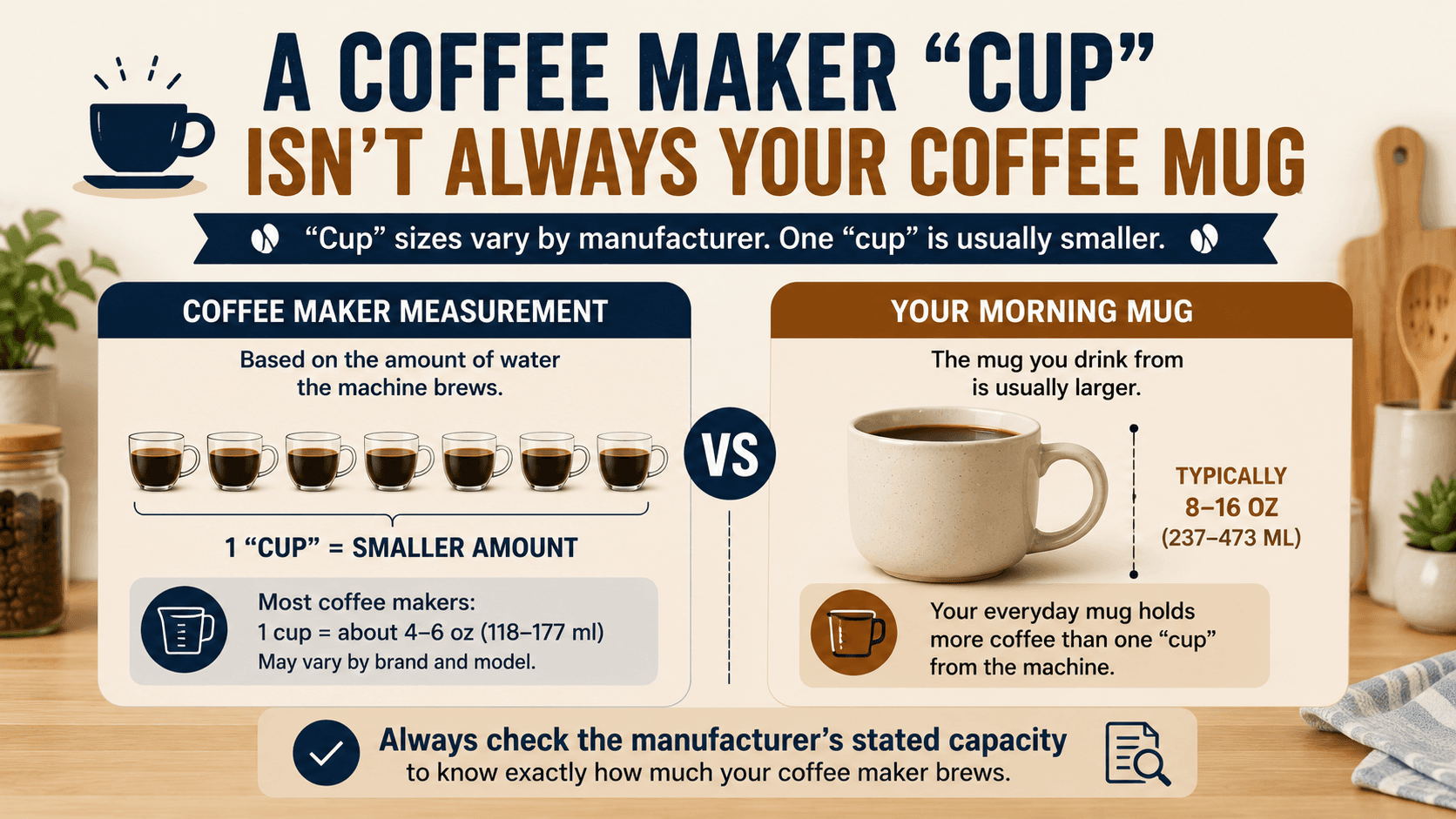
So a machine advertised at a big cup count can translate into noticeably fewer real-world mugs. If your favorite mug is large, a "full pot" can disappear surprisingly fast. Don't shop by the number on the box alone — compare it like this: carafe capacity, then the manufacturer's cup measurement, then your normal mug size. That's a far more useful picture.
10-Cup Coffee Makers: Who Are They Best For?
A 10-cup machine sits in a useful middle ground. It brews enough for several servings without automatically pushing you toward the largest drip machines on the shelf. It fits couples, one-person households that go through a few morning cups, smaller kitchens, home offices, and anyone who'd rather brew a fresh second pot than keep coffee warm for hours.
There's one advantage that's easy to overlook: less capacity can mean less wasted coffee. If you routinely brew 12 cups but pour the last portion down the sink, that extra capacity isn't doing anything for you. A slightly smaller machine may simply match your real routine better.
When a 12-Cup Coffee Maker Makes More Sense
A 12-cup model starts to make sense when coffee is a household activity rather than an individual one. Consider the larger size if three or more people drink coffee regularly, you entertain often, several family members head out around the same time, you fill travel mugs in the morning, or you just dislike brewing a second pot.
This is also why 12-cup machines are so common — they're flexible. You don't have to brew the full carafe every time, but the headroom is there when you need it.
Does a 12-Cup Coffee Maker Take Up More Counter Space?
Sometimes, but not always by much. Capacity alone doesn't tell you a machine's footprint. Two coffee makers with similar capacity can have quite different dimensions depending on the water reservoir design, control panel placement, carafe shape, filter basket location, and lid clearance.
In a small kitchen, don't compare width only. Check the height with the lid open. A machine can fit perfectly under your upper cabinets right up until you try to lift the reservoir lid to add water — and that's the kind of small annoyance you'd feel every morning.
Does the Coffee Actually Taste Different?
Not because of capacity. A 12-cup machine isn't inherently better at brewing than a 10-cup one, and a 10-cup machine isn't inherently more flavorful. Brewing quality comes down to the specific machine — its brew system, water distribution, temperature behavior, coffee-to-water ratio, and how you use it. So don't pick 12 cups expecting better coffee. Capacity is mostly a convenience decision; compare brewing performance separately.
What About Programmable Models?
This is where capacity and convenience start working together. If your goal is waking up to coffee that's already brewed, a programmable timer probably matters more than the gap between 10 and 12 cups. Features worth looking for:
- 24-hour programmability
- Auto shutoff
- Brew-strength settings
- Pause-and-pour (sometimes called "sneak-a-cup")
- Easy-to-read water markings
- Washable brew baskets
For someone brewing every morning before work, a good timer can improve daily life far more than two extra cups of theoretical capacity.
A Real Example: The BLACK+DECKER 12-Cup Programmable Coffee Maker
One example of the larger format is the BLACK+DECKER 12-Cup Programmable Coffee Maker we've researched here at BetterTomorrow. Its appeal isn't just that it says "12 cups." The more useful question is whether its mix of capacity, programmability, brewing design, and price fits your routine.
In our full review we break down its 24-hour timer, pause-and-pour, build quality, the fact that its 12-cup rating is based on 5-oz servings, and the patterns owners report over time.
Check price on AmazonMatching the Size to Your Household
One person
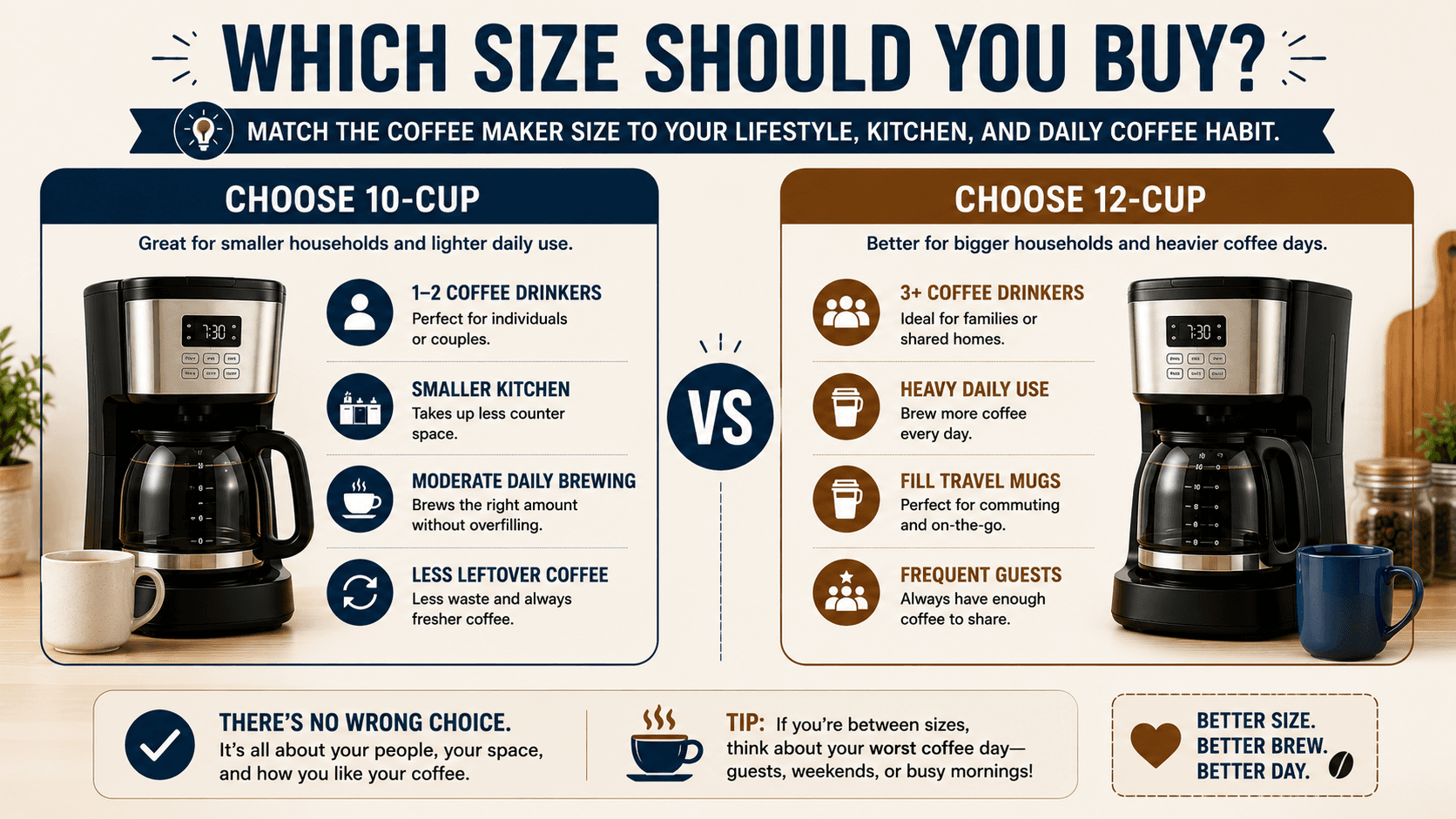
We'd usually pick the 10-cup here — and sometimes even smaller. If you drink one or two mugs in the morning, there's little reason to buy a large machine just for capacity. The exception is someone who drinks several cups across the morning, fills a travel mug, or entertains often. Otherwise a smaller machine takes up less space and nudges you toward brewing fresh instead of reheating.
Two coffee drinkers
Both sizes can work. If two people each drink two solid mugs in the morning, a 10-cup machine often covers it. If you both drink heavily, fill travel mugs, or frequently reach for another cup, the extra room on a 12-cup model becomes more useful. The better question isn't "which one holds more?" — it's "how much coffee does our household actually drink before noon?" That usually answers it.
A family or shared house
With several coffee drinkers, we'd lean toward 12 cups. The benefit isn't better coffee, it's fewer bottlenecks — no discovering that the first two people out the door already emptied the carafe. For shared use, also prioritize programmability, easy refilling, clear water markings, auto shutoff, simple controls, and easy cleaning. A machine several people touch needs to be convenient, not fiddly.
Don't Automatically Buy the Bigger Machine
It's tempting: if the price difference is small, why not get 12 cups? Because more capacity isn't automatically more useful. A bigger machine can mean more unused coffee, a possibly larger footprint, more coffee sitting on the warming plate, and capacity you rarely touch. The better coffee maker isn't the one with the biggest number on the box — it's the one that matches how you actually drink coffee.
Our Verdict
For most shoppers the call is fairly simple.
Choose a 10-cup coffee maker if you have one or two regular coffee drinkers, don't routinely need a large pot, or want efficient use of kitchen space.
Choose a 12-cup coffee maker if several people drink coffee every morning, you regularly fill larger mugs or travel cups, you entertain often, or you simply don't want to brew a second pot.
If you're still on the fence, don't let a two-cup difference decide it for you. Compare the actual dimensions, brewing features, programmability, ease of cleaning, and owner feedback — those differences will matter far more six months in than the number printed on the carafe.
If a programmable 12-cup model sounds close to what you need, our BLACK+DECKER 12-Cup Programmable Coffee Maker review covers the specs, brewing features, pros and cons, and recurring owner feedback so you can decide whether it fits your routine.
Check price on AmazonAs an Amazon Associate, we earn from qualifying purchases.